 Here is a set of rules that I hope you will find useful. The way I see it, readers’ time is far too precious to waste. People are made to feel guilty, or have somehow been conditioned to feel guilty, if they don't read every possibly useful report. Or every relevant newspaper article. But as writers, or content producers, we have a responsibility too. Here are some rules which I am gradually starting to live by myself.
Why I reject rejection slips
in News & views
Conventional wisdom has it that you should keep your rejection slips to remind you of how far you've come as a writer once you’ve established yourself. I’ve even read of people who proudly plaster their walls with the things.
Read MoreThe value of clippings
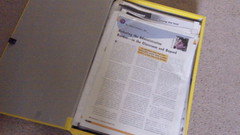 I feel a bit like the first person in Khalil Gibran’s story of The Gravedigger. It’s taken me years and years, but I am finally getting rid of boxes and boxes of my clippings, ie the articles I’ve had published.
This is not out of necessity, even though they do take up a fair bit of room in our loft. It’s just that I’ve decided I don’t need them any more, which made me think: why does anyone need to keep their clippings?
I think there are three main reasons.
Something of interest 10/25/2011
-
Take Creative Writing Outdoors! | Scottish Book Trust
Nice idea to get kids writing, and a pretty obvious one once you've heard it!
Would going to a nice natural environment work for adults too? Of course! And if you have a smartphone and an Evernote account, you can take notes and incorporate photos in a special "story ideas" notebook.
How to store clippings
 How do you keep your clippings?
If you keep them in paper format, they take up more and more room as your portfolio grows. If you keep them in boxes in the loft, as I do, you never get to see them anyway. I think if you’re going to store them in printed format you should go the whole hog and keep them nicely bound in some sort of presentation folder, and place them on shelves in your living space so that they can be admired by you and anyone who happens to browse your bookshelves!
The future of journalism
What technology skills should the modern journalist have? Earlier in the year Tony Johnston, of the Press Association, gave a talk online for a “Teachshare” session for Vital. It was fascinating, and a few things stood out for me:
Read MoreMy blackberry isn’t working: technology and language
Here’s a video that is a nice, humorous illustration of how technology has influenced our language.
Read MoreSome of my reference books
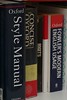 Just because I love technology and spend a lot of time on the web, and writing for the web, doesn’t mean I’ve eschewed books. I still use books extensively (and intensively) for my writing. Not any books either, but ones written or contributed to by experts.
I think if you’re serious about writing you don’t want to be messing about with so-called “crowd-sourced” information, which may or may not be correct.
The basic rule of blog headlines
Much has been written about what makes an effective headline for a blog article (and I should thoroughly recommend reading @copyblogger on the subject of How to Write Magnetic Headlines). For example, I’ve read on various writing-related blogs that headlines should be seeded with keywords for the purpose of SEO, or search engine optimisation. It all sounds pretty complicated, despite assurances to the contrary. Perhaps too complicated. Because the bottom line is that there is a very simple rule to observe.
Read MoreBrevity definitely IS the soul of wit
This afternoon I found myself in an emotionally challenging superfluous text situation. In other words, I became somewhat “wound up” by having to waste my time reading a long-winded sentence that was clearly designed to demonstrate the erudition of the writer rather than facilitate the understanding of the reader.
More on self-publishing
Clive Shepherd, an education consultant in the UK, has written a very useful post about the processes involved in self-publishing in paperback via Lulu, and electronically in the formats required by the iBook, Kindle and Sony Reader.
Read MoreTop tips from a self-publisher
John Betcher is publishing a series of top tips for self-publishers, in batches of 5 at at a time.
It’s all good stuff. John seems to do a lot of experimentation, and then reports back on how things worked out, warts and all.
Read MoreLanguage as a window into human nature
in Bits & bobs, Video
Fascinating video from the RSA. Well-worth watching by any writer, any student of language and nuance.
Read MoreIntegrity, journalism and PR
in News & views
 I attended a very interesting Westminster Media Forum seminar recently on the subject of journalism and public relations (PR). I thought I’d write about these issues in relation to integrity in blogging. It's an article that has been developing in my mind for some weeks now, and the seminar has helped me to put a few of my thoughts in order.
Good news: you can succeed as a bad writer, apparently
in News & views
According to an article in The Economist, negative publicity is fine for an unknown author. In Better to be reviled than ignored, we are informed that:
Read MoreBad headlines
If there’s one thing that really annoys me it’s chapter headings and article headlines where you can’t tell what the subject matter is until you read it. Who needs a situation in which you don’t know if you want to read something until you have read it? The way I look at it is that if the author can’t even be bothered being clear when he’s trying to entice you to read his stuff, why should you be bothered to oblige him by reading it?
4 Reasons to get published
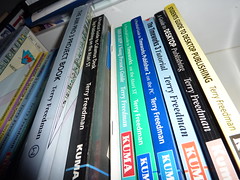 It's important to be published by a traditional publisher
Image by Terry Freedman via Flickr
In this day and age, in which anyone can publish and distribute their books electronically, or self-publish them by going down several routes (none of which need include the traditional vanity publisher), why should anyone bother approaching a traditional publisher? After all, very few of the thousands of manuscripts that publishers receive find their way into book form, and of those that do, very few hit the big time. There are, in fact, at least 4 reasons to try to get published by the age-old process of going to publishers.
How to find all articles in a series quickly
in How to
If you have come across one of the articles in a series, liked it, and decided that you would like to read the others in that series, you don’t have to go hunting all over the place for them!
Read More10 attributes of professional writers -- #10: Ask for permission to quote
 It’s always a good idea to ask permission to quote someone, especially if you’re (slightly) putting words into their mouths. “How might that arise?”, you might ask.
10 attributes of professional writers -- #9: Keep a record of sources
 If you’re doing research for an article, it’s easy to lose track of where you came across information, such as useful quotes you can use. This is where an electronic aide can come in very handy.
Two tools you might consider using are: