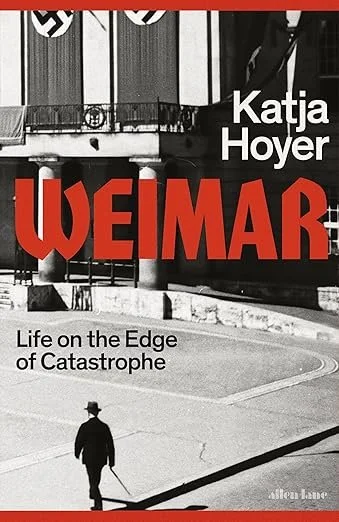
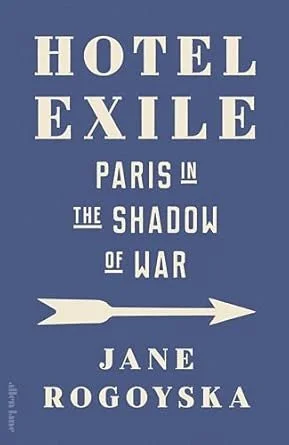
I’m reviewing these together partly because I have a separate review of each one being published in Teach Secondary magazine next month, and partly because they are both concerned with the same subject matter: the Nazi era.
Each one is extremely well-written, and takes a different perspective from the usual history book. Most histories deal with the era in a very sweeping kind of way, but these two focus on the minutiae.
Weimar, as its name suggests, focusses on Weimar, the town which gave its name to the short-lived Weimar republic. One of its main sources is a diary kept by a resident called Carl Weirich.
The book’s opening chapter is very powerful indeed: it describes the reactions of the Weimar citizens when an American general makes them walk to and around Buchenwald -- the concentration camp just 8 kilimetres from the town.
It becomes very clear from the book that events don’t happen in a vacuum, they don’t just spring out of nowhere. Thus we learn that a greater proportion of Weimar’s population voted for far-right parties than the rest of Germany, and antisemitism had become normalised there by the time Hitler came to power.
Also, I’ve always been sceptical of the view that (a) nobody knew what was going on, and (b) they couldn’t have done much about it even if they had.
The first one of these is, to me, simply untenable. Take just one fact: before Buchenwald had its own crematoria built, the bodies of the people murdered there were brought to Weimar for cremation. Didn’t anybody wonder why rhis was happening?
Regarding the second point, I agree that putting one’s head above the parapet can be extremely unwise in such circumstances: not all of us are brave enough to stand up publicly and loudly to a despotic regime.
But there are things that one can choose not do, such as denouncing friends and neighbours or, as Weirich did, support the SS with financial contributions. He may not have denounced anyone as far as I know, and he may not have joined the SS, but it would be a stretch to assert his innocence.
Hotel Exile focusses on the Hotel Lutetia, where James Joyce lived and where Picasso was a regular guest. We learn about the stateless people who found themselves there after they’s been thrown out of or had fled Nazi Germany. During the Hitler years it was taken over bythe Nazis, and after the war it became a sort of hospital for people returning from the concentration camps. Parts of that last section almost had me in tears.
Often when I read these kind of books I discover something that I didn’t know, and which I feel guilty about for not knowing. For example, a few years ago I was in a bookshop leafing through a book about the concentration camps and discovered that the prisoners were not allowed to have a handkerchief. I suppose that was part of the process of dehumanising them. And in Hotel Exile, I discovered that at some point Jews were banned from using the telephone. My first thought was: how could they have enforced that? And then I realised that there were so many people who were happy to denouce others that they wouldn’t have had to worry about that.
Both of these books are very well-written, and draw the reader in.
I will finish with a quotation from Hotel Exile:
“How to define the beginnings of a cataclysm? Perhaps like this: a series of small, incremental changes that gradually creep up on complacent citizens, busy with lives that are at once so comfortable as to admit no possibility of change, and too filled with the personal dramas that distract us all to notice something worse.”
This essay first appeared in Eclecticism.