Below you will find two versions of a book review. The first is the one I submitted to the editor of Teach Secondary magazine, while the second is the version he actually published.
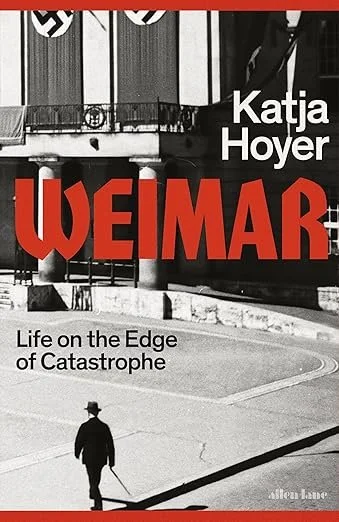
Weimar: Life on the edge of catastrophe
My version
Weimar: Life on the Edge of Catastrophe
(Hoyer, Allen Lane, £30)
Weimar, the birthplace of the optimistic but short-lived republic of the same name, a place called “home” by Goethe, Liszt and Nietzsche and a mere eight kilometres from Buchenwald.
The book starts at the end, with an American soldier forcing the local populace to witness what was being done in their name. The story is told through the lives of individuals like Carl Weirich, who kept a diary spanning decades.
By focusing on the quotidian concerns of ordinary people, Hoyer makes us realise that while individuals may lack the power to affect the sweeping societal changes underway, they are not entirely free of responsibility for them.
We also learn that catastrophic events don’t happen in a vacuum: Weimar was already much inclined to antisemitism and far right “solutions” before Hitler was even born. And we also learn, as if we needed to be shown, that making accommodations with extremists ultimately fails.
Reviewed by Terry Freedman
Published version
Weimar was the birthplace of the optimistic, yet short-lived republic of the same name, and the place that Goethe, Liszt and Nietzsche called 'home', situated a mere 8km from Buchenwald. Weimar starts at the end, with an American soldier forcing the local populace to witness the acts that were being perpetrated in their name.
Hoyer then proceeds to tell the story of Weimar through the lives of individuals like Carl Weirich, who kept a diary spanning decades. By focusing on the quotidian concerns of ordinary people, Hoyer helps us appreciate that while individuals might lack the power to affect the sweeping societal changes happening around them, they're not entirely free of responsibility for them. Thus, we learn that Weimar was already inclined towards antisemitism and far-right 'solutions' before Hitler was even born - and that efforts at making accommodations with extremists are always ultimately doomed to failure.
Reviewed by Terry Freedman
This review was first published in Teach Secondary magazine. To comment on it, and to read an alternative version, please read this: Compare and Contrast #9