I submitted my review of this book to Teach Secondary magazine, an educational magazine in the UK. The first review below is what the magazine published. The second one is what I actually wrote! In substantive terms there is little difference between the two, but you may find it interesting to see what the editor altered.
Published version
(Charlotte Blease, YUP, £18.99)
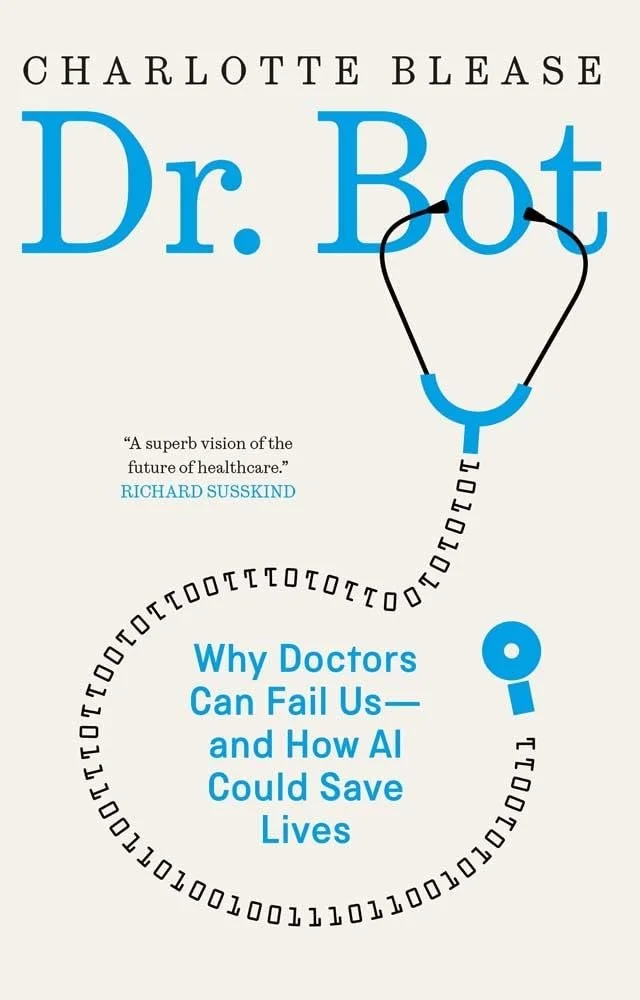
Click the pic to see this book on Amazon (affiliate link)
Click the pic to see this book on Amazon (affiliate link)
For many working in the education profession, their considerations of Al's pros and cons will be largely centred on how it can enable instances of student plagiarism, or potentially reduce the burden of teachers' admin.
In the comprehensive and highly readable Dr Bot, Blease tackles a far wider range of issues, albeit some that are particularly apposite for those working in schools. Why, she posits, are doctors often loath to use Al, even when it has the capacity to be extremely helpful?
She goes on to explore how some patients can be more willing to open up and share personal information with Al bots than with human doctors, thus enabling medical staff to get an unfiltered picture of what's actually going on in patients' lives.
Could this form of triage be an approach we might one day see echoed in schools? The resulting impact on test results could certainly be interesting.
This review was first published in Teach Secondary magazine.
My original version
While the education world is largely focused on artificial intelligence as either a means of plagiarism, copyright infringement or reducing the burden of teachers’ admin, this considers a far wider range of issues, some of which are very apposite for schools.
For example, why is it that doctors can often be very loth to use AI even though it can be a real help? As might be expected, patients often open up more to AI bots than to human doctors, not to be provided with a diagnosis but to enable the doctor to receive an unfiltered picture of what’s going on.
Could this form of triage be an approach to consider in schools where appropriate? Imagine how this could be applied to test results.
Very comprehensive and surprisingly readable.