
This is an attempt to write a short review in the style of those in the New York Review of Books. The reviews there usually cover more than one book, and include the reviewer's personal opinions. That's what I've done here. I hope you like it.
I went to see a play last week: Here There Are Blueberries. It is, in essence, an illustrated documentary of the discovery of hitherto unseen photographs taken in Auschwitz, sent to an archivist at the US Holocaust Memorial Museum. There was very little action or, for want of a better word, theatricals. In other words, it adopted an unusual approach. Yet, or perhaps because of that, it worked. In fact, I think it worked very well indeed.
The play brought up a number of issues. One that was emphasised in the post-play discussion was the idea that anyone could become a perpetrator. Well, I can see that a child brought up in the Nazi era might think the Nazi philosophy was perfectly normal and acceptable. I can also give the benefit of the doubt to the people who were small cogs in a vast machine, like the girls who worked in the messaging centre. I don’t believe they didn’t know what was going on, especially as they were receiving paperwork relating to the purchase of Zyklon B, the gas used in the gas chambers, but then what were they supposed to do about it? I find it much harder to accept that the person who designed the camp, the doctors who experimented on people and the people who commissioned the building of the gas chambers and crematoria were just the same as the rest of us. To say that anyone could do those things seems to me a way of exonerating them, or at least diminishing their crimes.
A more nuanced approach is that put forward by Rauch in Conversations With Third Reich Contemporaries (my review):
Rauch puts people into different categories, which in her case are victims, perpetrators and bystanders. However, a key insight is that these roles are malleable. For example, bystanders may become perpetrators. Furthermore bystanders, by seeming to tolerate or even approve of injustices, violence and crime, become, in effect, accomplices.
Another issue raised was what I would refer to as second and third generational trauma. This is a well-known phenomenon when related to the children and grandchildren of the survivors, but I haven’t come across much written about the descendants of the perpetrators. Imagine discovering that your father or grandfather was a murderer.
A few years ago Elaine met an elderly German lady who. as a young girl, idolised her father. Then when she was 16 her mother informed her that her father had been in the Gestapo. This lady has spent her whole life trying to make amends for something she had absolutely nothing to do with. I should be astonished if she were alone.
The photos in the play were harrowing because of their sheer ordinariness. The experience reminded me of watching the film Night and Fog (currently showing on Mubi). An image that will stay with me forever was a photo of mounds of human hair, taken from the prisoners. The camera pulled back, and showed a virtual mountain of the stuff. I saw the film whilst at college. The Liberal Studies tutor, Arnie Kurtz, who I wrote about here (I’ve depaywalled that post now) showed it in one of our lessons.
It was the custom of my friends and I to repair to a local café after the Liberal Studies lesson, to discuss the lesson, talk about girls, and to put the world to rights. After that lesson, we went to the café, ordered our coffees, and then sat in utter silence for an hour.
For me, the most disappointing aspect of the evening was the post-play discussion. This consisted of a panel of three people, including an American who delivered the obligatory swipe at ICE, and who all agreed we should be nice to each other. Well yes, that is a lovely idea but may not be enough to confront evil. What if we regarded Ecclesiastes (“To everything there is a season…”) not as a description of Shangri La but as a set of commands?
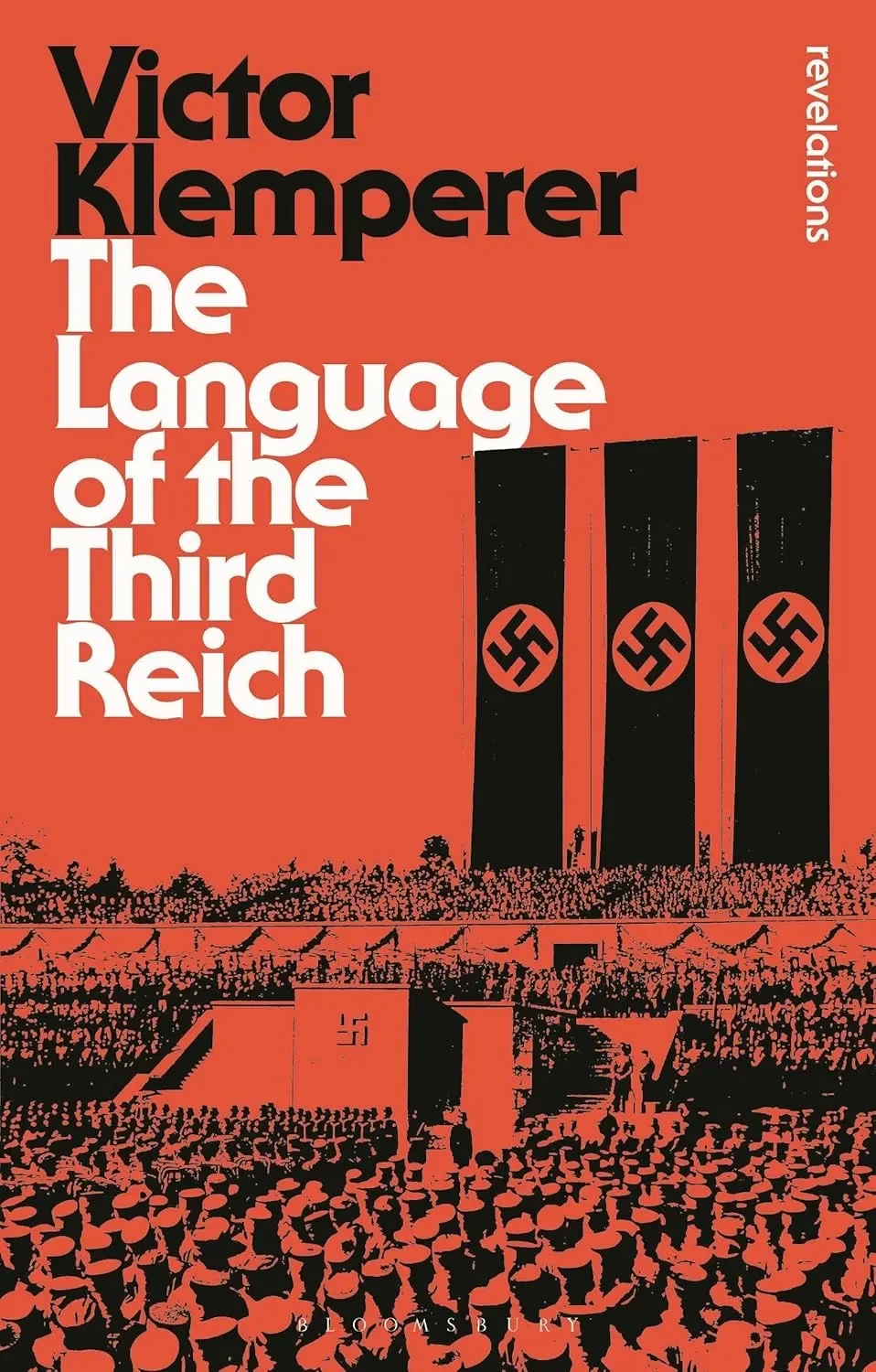
Click the cover to see this book on Amazon (affiliate link)
The panel agreed, quite rightly, that atrocities start with words — but had little more to say about it. This did come up in the play itself. When new arrivals to Auschwitz were processed, they had either “Work” or “Special Treatment” put next to their name. “Special Treatment” was code for “To the gas chambers”. Anyone interested in the manipulation of language to suit a totalitarian state in general should, of course, read 1984 by George Orwell. But for a specific analysis of this phenomenon in relation to the Nazis, read Victor Klemperer’s The Language of the Third Reich (Amazon affiliate link).
Words do matter, but so too does the omission of words. Recently the BBC informed us that the Nazis murdered six million people in the Holocaust. No, they murdered eleven million people, six million of whom were Jews. You can read the BBC’s apology here.
Going back to the play, it is absolutely worth seeing if you have the opportunity.. These were horrific, but not for the reason you might think. These were photos of the perpetrators. It’s hard to forget the one of the camp’s personnel, including Mengele, celebrating because they had succeeded in their mission of murdering 350,000 Jews in the space of two months.