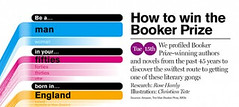
 Ever wondered how to win the Booker Prize? Well, thanks to the Slow Journalism company’s data-crunching, the secret is revealed. Hint: it helps if you are a 50 year-old man working on his fourth novel, apparently!
Here’s the data.
 Ever wondered how to win the Booker Prize? Well, thanks to the Slow Journalism company’s data-crunching, the secret is revealed. Hint: it helps if you are a 50 year-old man working on his fourth novel, apparently!
Here’s the data.
 What can be worse than losing your beautifully-crafted prose that you’ve published as blog posts? In this short series I’m looking at how you you can try to guard against the inconceivable happening. Today, I’m looking at Blogger. If you have a blog using the Blogger platform, then here’s how to back it up.
The word “paranoid” is defined in the Oxford English Dictionary as
“exhibiting unnecessary or extreme fear; characterized by unreasonable or excessive suspicion of others.”
Well, you know the old joke: Just because you're paranoid i doesn’t mean they’re not out to get you!
In a similar sort of way, I don’t think there is anything “unreasonable” in being paranoid about losing the content on your website.
 So, you have a Word document or a text file, and you want to convert it into various ebook formats. There are formats for Kindles, Apple, the Nook and several others, so where do you start?
 Willow and his family would like to wish all our readers a Merry Christmas and a Happy New Year!
 Writer Beware is a blog that alerts writers to scams, and possible scams. In some respects it is like a consumer organisation for writers.
 While I was writing the blog post entitled Handwriting on the Web, I was quite surprised that the typeface appeared as it was intended to: I’d assumed I’d have to take a screenshot of it to make it appear properly in a web browser. As it turns out, my original instincts were correct.
 So, you’d like to use a handwriting font on your website or blog? It’s pretty easy, but you ought to think about the impression you want to create. And perhaps use it sparingly, unlke in this article.
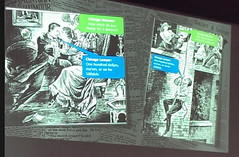 Victorian humour? A contradiction in terms, surely? Not according to Bob Nicholson, a lecturer in history who is on a mission to make Victorian jokes funny again (which presupposes they were funny in the first place, of course, but one assumes they were!).
Now, you may think this has nothing to do with writing, but it has. Bob is using a computing technique known as “text mining” to trawl through loads of Victorian publications held by the British Library, and extract jokes.
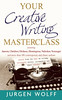 I love books that you can dip into, and I am always interested in what writers have to say about their craft. Jurgen Wolff’s Your Creative Writing Masterclass has proved to be highly rewarding on both counts.
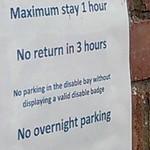 I think this notice about parking illustrates why it’s not a good idea to rely solely on yourself when it comes to proofreading and editing. The notice contains two errors that could, and should, have been avoided.
 Many moons ago I took up amateur dramatics for a while. That may seem a bit odd for someone who likes to keep himself to himself, but someone invited me to see a play he was in, and I thought it looked like fun.
I have to say that the thought of going on stage was a terrifying experience. Note that I said the thought of it, not the experience itself. I’ll try to explain.
 “There’s Terry, always with his head in a book or a comic.” My mother’s gentle admonishment was a constant feature of our household. But it wasn’t an admonishment against reading, which my parents actively encouraged (books were revered in our home because they were books, almost regardless of the content). Rather, it was a cry of frustration over the fact that once I was engrossed in a book or a comic, anything she said to me literally fell on deaf ears.
 In the article 3 reasons that non-fiction authors should speak, I suggested why public speaking can be important to an author. But the question arises: should that be at any price?
My natural inclination, my default position if you will, is that if you’re good enough to be asked to give a talk, do a presentation or run a workshop, then you deserve to be paid for it. As my wife so succinctly put it to me: “Nothing doesn’t buy anything.”.
However, situations, like people, are different from one another. At the end of the day, if you are asked to give a talk without payment, your decision of whether or not to accept is one that involves weighing up the (perceived) costs and benefits. Here are the considerations you might wish to take into account.
 One of the things that authors are expected to do is public speaking. Even if you hate the idea, it’s a good thing to do for three reasons.
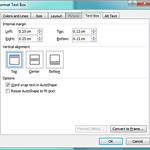 If you have the occasional desktop publishing to do, or if you only require a sort of limited desktop publisher or simply don’t have the time to learn a whole new program, Word will do fine. But, to borrow from Clint Eastwood, a program’s got to know its limitations. In the article Using Word for desktop publishing, I noted that text boxes are good for enabling you to place text anywhere. Furthermore, you can link text boxes, so that if text outgrows its text box, you can make it flow on to another one.
Back in April 2014 I penned a few lines on using Word as a desktop publishing tool. On the whole it works, but, as I noted then, it does have serious limitations.
I mentioned in that article that it was impossible to use automated cross-referencing between text boxes. Since then I have discovered something even worse.