 A couple of weeks ago I asked: Is Digital Rights Management effective against piracy?
2000AD ditches DRM
A couple of weeks ago I asked: Is Digital Rights Management effective against piracy?
Self-publishing
A couple of weeks ago I asked: Is Digital Rights Management effective against piracy? Well, the London Book Fair has been and gone. Is it only a week ago that I was trudging home with publishers’ catalogues and notes from the various sessions I attended?
I found it really useful: three days’-worth of excellent talks and discussions, for the princely sum of £35.
 A recent piece of research from the Authors’ Licensing and Collecting Society (ALCS) makes for some depressing reading – unless you are extremely optimistic.
The figures relate to 2013, and are not as good as their equivalents of ten years ago, in 2005. Well, not for the most part anyway. Here are some of them:
 I spent another day at the London Book Fair today. This time, I had earmarked just two talks to go to, the rest of my time being given over to wandering around and seeing what looked interesting.
 I always look forward to the London Book Fair – I think it’s the thrill of being surrounded by so many books! Today was the first of three, and I used it to attend seminars for the most part.
 After quite a long gap, I’ve decided to self-publish a few books. I thought it might be interesting to write up my journey, because perhaps the research I undertake will be beneficial to others.
 After quite a long gap, I’ve decided to self-publish a few books. I thought it might be interesting to write up my journey, because perhaps the research I undertake will be beneficial to others.
 After quite a long gap, I’ve decided to self-publish a few books. I thought it might be interesting to write up my journey, because perhaps the research I undertake will be beneficial to others.
Today I’m looking at whether or not you should choose Digital Rights Management, or DRM, as a way of preventing your ebooks being illegally copied.
After quite a long gap, I’ve decided to self-publish a few books. I thought it might be interesting to write up my journey, because perhaps the research I undertake will be beneficial to others.
Today I’m looking at why have I chosen self-publishing rather than traditional publishing.
After quite a long gap, I’ve decided to self-publish a few books. I thought it might be interesting to write up my journey, because perhaps the research I undertake will be beneficial to others.
Today, I’m clarifying what the term self-publishing means because, unfortunately, it’s not as obvious as you might think.
Starting tomorrow, a new series of occasional posts about my research into self-publishing.
The first two articles are:
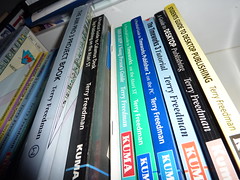 It's important to be published by a traditional publisher
Image by Terry Freedman via Flickr
In this day and age, in which anyone can publish and distribute their books electronically, or self-publish them by going down several routes (none of which need include the traditional vanity publisher), why should anyone bother approaching a traditional publisher? After all, very few of the thousands of manuscripts that publishers receive find their way into book form, and of those that do, very few hit the big time. There are, in fact, at least 4 reasons to try to get published by the age-old process of going to publishers.
 I'm in the process of collating top tips and resources about designing ebook covers. I've compiled a list of useful links (see below), which I'm adding to continually, but if you have any advice based on experience it would be interesting to hear about it.
 Amanda Katz asks: Will Your Children Inherit Your E-Books?
It’s a fascinating article. Is rummaging through the contents of a Kindle that belonged to your grandmother the same as rummaging through boxes of books that belonged to her, assuming that you can even access them?
 I attended a really useful seminar – well, two seminars – run by the Society of Authors. The morning session was on tweeting and blogging, and the afternoon one on ebook self-publishing.
