
I know that autobiographies are, by definition, self-referential, but Stan Lee's one is actually written in a self-referential way.
Read MoreThe anatomy of the perfect blog post
This infographic appeared in my inbox. I am not sure whether all of this would work for every kind of blog and every kind of audience, but it has a few interesting suggestions.
Read More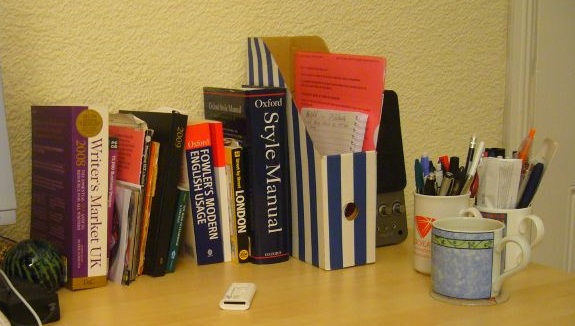
Some useful reference books for writers
8 useful books for writers
I've either read, or am in the process of reading, several books to do with writing or self-publishing. Here's a list of 8 that I have found useful.
Read MoreSuccess!

Our new mobile-friendly design is up and tunning. Read on for a note about teething problems, and next steps.
Read MoreWe’re moving…
in News & views
 I’m in the process of changing this website to a mobile-friendly version. With any luck, this website won’t disappear in the meantime. If you do happen to get one of those horrible “Page not found” messages, please keep trying. Apparently it can take up to 72 hours for it all to come to life again.
7 ways to manage technical support for writers
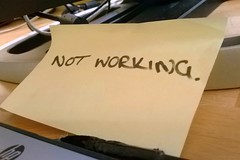 Most writers use a computer of some sort these days, and the thing about computers is that they go wrong. It’s not an ‘if’, but a ‘when’. In my experience, it happens when you have a deadline for the same day or when you were just about to dash out of the door to start your holiday. Unless you’re working for a company or some sort of co-operative, chances are you are your own technician. So what can you do to minimise the pain?
Reflections on writing and technology
 Many of my articles on this blog are reflections on writing and technology. Although there are some writers who eschew the idea of technology, I believe that if you define “technology” widely enough, it becomes obvious that all writers use technology.
Even those who are fortunate enough to have an assistant to whom they can dictate their thoughts, and who will then type them up, are using technology – albeit at one remove
5 Ways to further your writing project when you can’t work on it directly
 There can be several reasons why it is not possible to work on your book, blog or other writing project. Maybe you’ve saved it in the cloud, and don’t have an internet connection. Perhaps you didn’t think you would have the time to write, so didn’t take your laptop with you. Or maybe you’re waiting outside the school gates. Whatever the reason, you can usually still do something. Here are the strategies that I’ve found work for me.
7 ways to tackle writing a book when you need to write articles too
 My aim is very simple: I should like to generate a passive income. I could do so by selling affiliate products or by having ads all over the place. But I prefer to do it, mainly at least, by writing.
But there’s a problem.
How to make a living from writing: new video series
 Joanna Penn has launched a new series of free videos on the theme of how to make a living from writing.
The Writing Machine (Patent Pending)
7 Ways to improve your writing
in How to
 Every craftsperson should work on improving their craft. So, how do you become a better writer? These are the things I’ve found to be very useful. I hope you do too.
Thoughts on Amazon’s new royalties system
in News & views
 Amazon very recently introduced a new way of calculating royalties for books borrowed in the Kindle Unlimited and Kindle Owners’ Lending Library schemes. Whereas previously royalties were based on the number of times a book has been borrowed, they will now be based on the number of pages read. Amazon will define what a page is according to font size and other parameters, so authors can’t pull a fast one by making the font huge!
How to display your word count
in How to, Technology
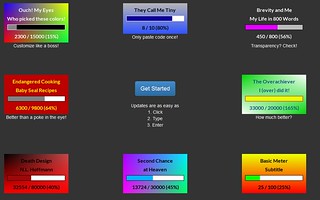 I am not sure if displaying one’s word count is a good idea or not. On the one hand, you are publicly committing yourself to writing, because if your word count remain static then it appears to everyone that you are not doing anything. On the other hand, appearing not to be doing any writing could be quite embarrassing.
My Scrivener Dashboard
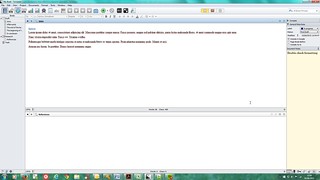 After a year of prevaricating about using Scrivener as my main writing tool, I am rapidly heading towards doing so. The reason is that I discovered that I can have a view on my work in which I can see everything I need to see all at the same time. I call this “My Scrivener Dashboard”, and in this post I point out what each part of it is, and why I am starting to fall in love with Scrivener.
Freelancing vs authoring Part 2: Authoring
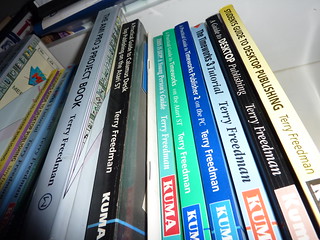 If, like me, you enjoy writing and you would like to earn money from it, should you go down the freelance writing route or write books, or both? In the first part of this two-part series I looked at the advantages and disadvantages of freelancing, ie writing articles for newspapers and magazines. In this part, I consider the advantages and disadvantages of authoring, ie writing books.
Review of 30 Day Blogging Challenge by Nikki Pilkington
 If you're looking for a handy, no frills book of suggestions for blogging, this book should meet your requirements. Having been designed as an email course, 30 Day Blogging Challenge, written by Nikki Pilkington, consists mainly of 30 very short articles on different aspects of blogging. Being able to buy the whole lot in the form of a book is excellent for those of us for whom deferred gratification is an alien concept.
Review of Polish Your Fiction
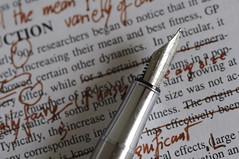 Polish Your Fiction is another title in Jessica Bell’s “in a nutshell” series. It is subtitled “A quick and easy self-editing guide”, which is a very apt description.
Freelancing vs authoring Part 1
 If, like me, you enjoy writing and you would like to earn money from it, should you go down the freelance writing route or write books, or both?
From my experience, here are the pros and cons of freelancing.
5 reasons that writers should use spreadsheets
Many people have the impression that spreadsheets are complicated, used for number-crunching, and hold little of interest to the writer. However, as an organisational and time-saving tool, a simple spreadsheet is hard to beat. Here is how I use them in my writing.
Read More